Will offering a reward help stop your child’s bedwetting?

I’m often asked if it’s a good idea to introduce a reward as an additional incentive to changing children’s bedwetting habits. On the face of it, it does sound like a good idea – human beings are naturally goal-seeking individuals and surely if you’re going to have to push yourself in order to achieve something, then rewarding yourself with an additional carrot may well make all the difference.
Parents are already encouraged to create star charts, give pocket money and dangle more expensive treats such as the promise of a new pair of trainers, to motivate their children on a daily basis.
Extrinsic rewards are not effective motivation
However, psychological studies show that our interest in completing a task – our intrinsic motivation – begins to rapidly decline if we introduce an extrinsic reward. This is because as soon as you take your attention, your awareness and focus away from your goal, you begin to make it much harder for yourself to succeed. Every ounce of brainpower should be channeled into focusing on the task in hand and the prospect of success.
Of course, there has to be something positive to be gained out of any kind of task, otherwise there would be no point in doing it. But keeping your end goal in sight as your ‘reward’ is going to increase your chances of getting there.
The end result is the ultimate reward!
So, in the case of a child who is following a programme, such as Stop Bedwetting in 7 Days, to stop their bedwetting habit for good, their ultimate reward will the be prospect having dry beds and the confidence to go on school trips and sleepovers with friends. The more that the child can sit and think and dream about how good life will be once they’ve ditched this miserable habit, the more likely they are to get there.
And think too, about what is likely to happen if that bedwetting child takes a little longer to get dry at night. Not only will they have the disappointment of waking up in a wet bed, but also the double disappointment of losing out on their treat or reward.
Success is more likely without the distraction of a reward
Many psychological experiments have been carried out monitoring people’s progress in achieving tasks when rewards are offered. In each case, the results have been replicated, with the conclusion that more pleasure and success can be derived from a task if there’s no distracting element such as a reward.
Which explains why Olympic athletes are more likely to be successful if they focus on winning the race, rather than getting a gold medal.
If your child is still wetting the bed.
Bedwetting can feel frustrating and confusing, especially when it doesn’t seem to be improving.

Alicia Eaton is a Behaviour Change Psychotherapist based in London's Harley Street for over 20 years, working with families, supporting both adults and children, helping to tackle difficult problems such as anxiety, bedwetting, eating and weight issues. She also offers advice and training to schools, teachers, clinicians and professionals working with children.
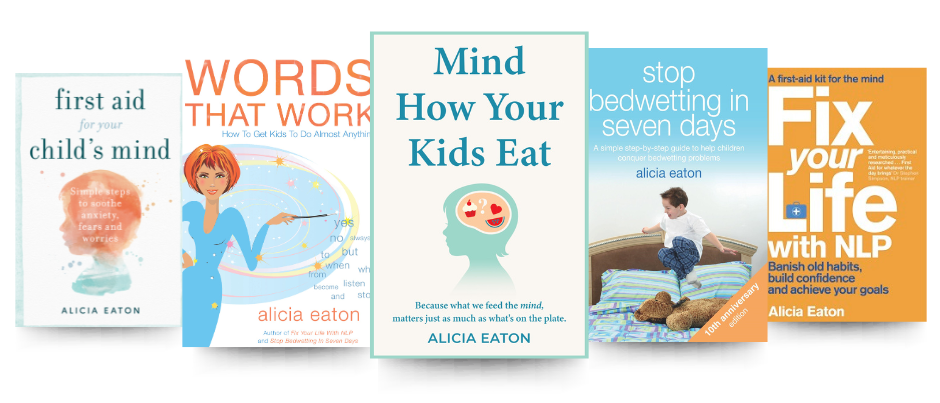
Alicia is the author of several best-selling books including ‘Stop Bedwetting in 7 Days’, recommended by NHS hospital clinics and ‘First Aid for your Child’s Mind', now published around the world in seven different languages.
Her latest book ‘Mind How your Kids Eat’ gives psychological insights into how our children learn to eat and what to do about food fussiness, sensory sensitivities, ARFID, junk food cravings and weight issues.