Why bedwetting happens - and what helps
Bedwetting in children & teenagers
How to solve it - for good
Whether your child is in primary school or a teenager, understanding what’s happening is the first step towards dry nights. Bedwetting is treatable — and with the right approach, children can learn to stay dry and wake when it matters.



If you’re dealing with endless washing, night-time pull-ups or worries about sleepovers, you’re not alone.

Bedwetting - also known as nocturnal enuresis
- is more common than many families realise.
Latest statistics show that around 750,000 children in the UK, and over one million in the US, continue to struggle with this problem over the age of six.
The true figure is probably much higher, as bedwetting continues to be the secret problem that no-one likes to talk about.
Alicia Eaton
Behaviour Change Psychotherapist | Author | Speaker | Trainer

I’ve been helping children and teenagers overcome bedwetting problems for over 20 years from my practice in Harley Street, London, and I understand just how challenging this can be for families.
As a Behaviour Change Psychotherapist, I developed my 'Stop Bedwetting in 7 Days' method after working with hundreds of children struggling with this problem. It's regularly recommended by NHS clinics and GPs and I've continued to update it with the latest research from neuroscience and behavioural psychology.
Bedwetting can feel exhausting and confusing. Most children become dry at night by around age five, but for some it continues into later childhood and the teenage years and beyond.
This doesn’t mean the problem is permanent. But the longer it continues, the more established the pattern can become.
Over time, bedwetting can turn into a habit. And like any habit, it can be changed with the right approach.
Waiting for a child to simply ‘grow out of it’ can mean years of disrupted sleep, worry and embarrassment — for both children and parents.
The good news is that many parents have discovered that with the right sort of help, it's possible to solve this problem once and for all. Just as you once helped your child learn daytime toileting, it's possible to guide them through 'dry bed training' to change this pattern and most children can learn to stay dry much sooner.
Bedwetting can feel overwhelming - but it can be solved.
What causes bedwetting?
Bedwetting - also known as nocturnal enuresis - is common in younger children as bladder control develops.
By around age seven, most children are dry at night. However, some continue to experience difficulties into later childhood and the teenage years.
There isn’t always one single cause. A number of factors can be involved, including:
Bladder development
Hormone levels
Family history
Constipation or toilet habits
Sleep patterns
Stress and anxiety
Because there are often several factors at play, a one-size-fits-all solution doesn’t always work. This is why a structured approach that looks at the whole pattern is often more effective.

There’s also a co-ordination that needs to take place between the mind and the bladder.
Some children struggle to recognise internal cues such as hunger, thirst, temperature and the need to use the toilet. This is known as interoception.
At the same time, repeated patterns of behaviour become our habits - and once established, these can be difficult to change without the right approach
This is the focus of my Stop Bedwetting in 7 Days training method - a structured approach designed to help children develop better awareness, improve sleep, and change the pattern over time.

One simple place to start is with food and drinks.

Should you contact your doctor or paediatrician?
In most cases, bedwetting doesn't require medical treatment, but it’s always a good idea to have a consultation if:
It starts suddenly
There are daytime symptoms
There is pain or discomfort
There are other health concerns
Or, it’s simply been going on for many years and you haven’t spoken to anyone about it for a while. It’s good to review the situation.
Usually, these consultations will eliminate more serious causes and so, a behavioural approach for solving this is often the most effective next step.

Why alarms and medications don't always work for everyone
It is possible to try to tackle the problem using a bedwetting alarm and this is often the recommended first treatment — but some families find these inconvenient to use and they may cause a bit of anxiety.
For slightly older children, doctors can prescribe medication such as Desmopressin which reduces night-time urine production. This can be helpful for short-term situations such as a sleepover or a school trip, but there can sometimes be side effects such as headaches, too.
These approaches can be helpful in some situations — but they don’t work for everyone. They tend to focus on managing the symptom, rather than helping the body develop stronger communication between the brain and bladder.
Most families prefer to find a more natural solution — one that helps children develop long-term bladder control.
"Bedwetting can be solved by improving communication between the brain and the bladder at the same time as improving quality of sleep."
A different way to solve bedwetting
The Stop Bedwetting in 7 Days method takes a different approach.
Rather than focusing only on symptoms, it looks at the underlying pattern — how the mind and body are working together at night.
Using a structured behaviour change method, it helps to:
improve sleep quality
strengthen awareness of internal signals (interoception)
help develop communication between the brain and bladder
and replace the existing habit with a new pattern of staying dry
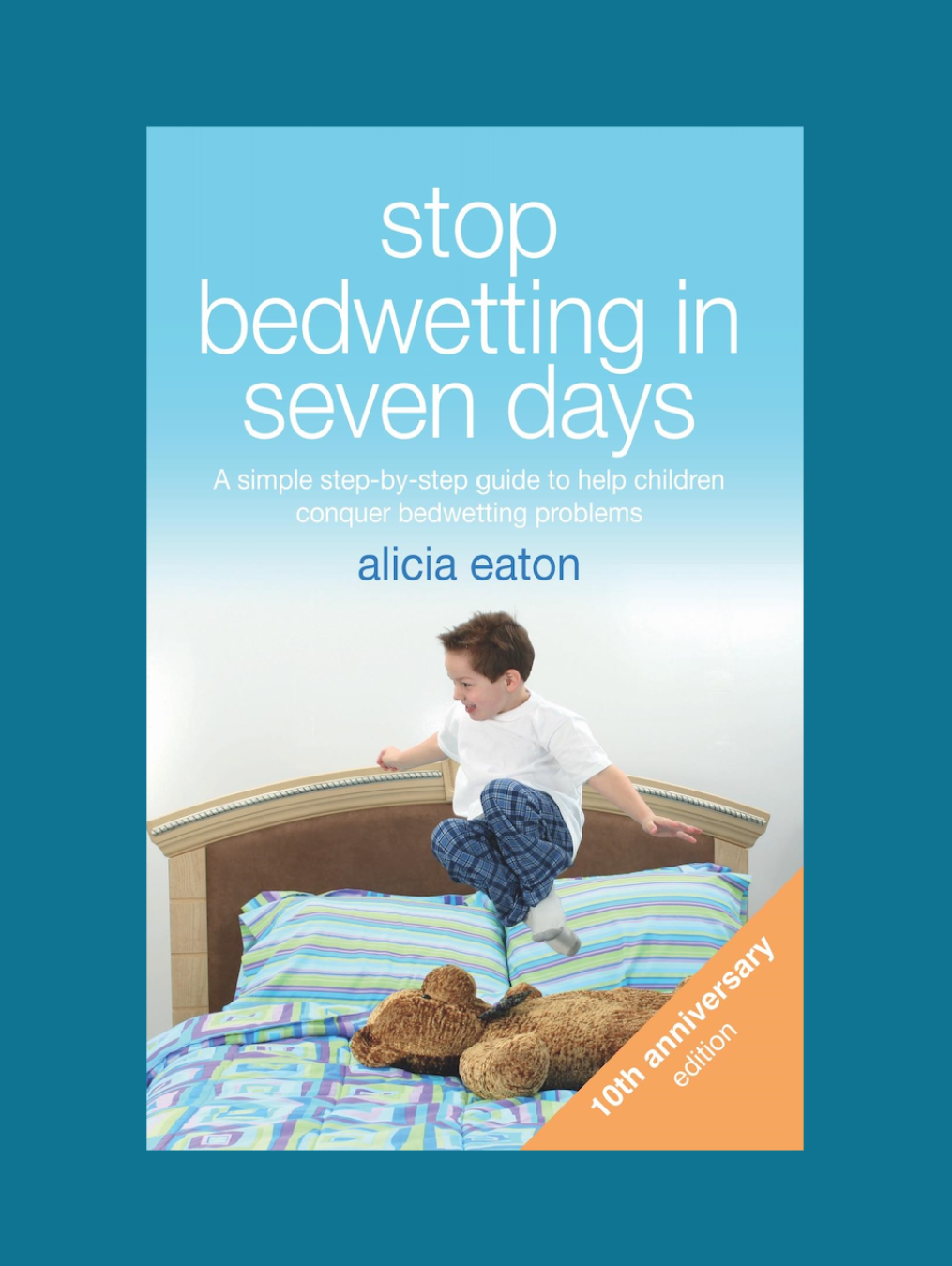
The programme is explained step-by-step in my book along with simple exercises that children and teenagers can follow at home. As well as practical advice, it incorporates behavioural change psychology techniques such as visualisation and hypnotherapy which also help with sleep patterns.
It’s a calm, practical approach that can be more effective over time for many children. It’s regularly recommended by doctors, clinics and hospitals all around the world.