Can Star Charts help solve bedwetting?
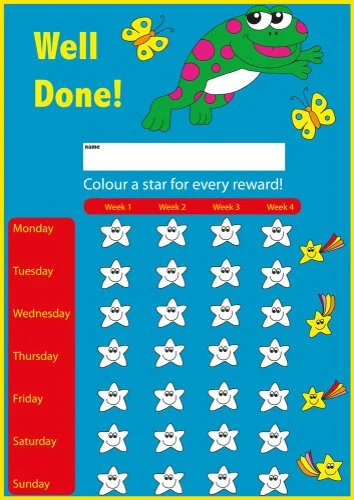
Star charts are a very popular way to get your child to do something so it’s not surprising that they are often suggested as a way to solve bedwetting. On the face of it, they don’t seem like a bad idea. All a parent needs to do is explain to their child that they should try to keep their bed dry at night and when they do, they’ll receive a star on the chart as a reward.
If only it were that simple!
Bedwetting is not a conscious behaviour
Having studied the science behind behavioural change and habit formation for over 20 years, I can tell you that there is a big difference between ‘outside behaviours’ that happen in the conscious mind and ‘inside habits’ that have become more deeply embedded on the subconscious mind. Let me explain.
If you want to encourage your child to brush their teeth twice a day, tidy up their toys or put away their shoes each time they come into the house, then a star chart might act as a useful prompt or reminder. These are conscious habits that your child can easily change with a little bit of encouragement.
Bedwetting on the other hand, occurs at night-time when your child is asleep. It’s extremely rare for a child to set out to deliberately wet their bed at night. It happens unconsciously – and over time it becomes an automatic habit.
Star charts will not provide a long-term solution
A star chart can work in the initial instance by encouraging your child to consciously determine to wake up at night instead of sleeping through. The effect is similar to setting an alarm clock to wake you up extra early to go on holiday, for example. When you know you have to wake up at 4am to catch an early morning flight, most of us will spontaneously wake up 5 minutes before the alarm goes off. It feels like magic, doesn’t it?
This ‘magic’ effect can last for a few days, but after a while it will wear off. There is a limit to how long you can keep it up for. It’s the same when we try to diet and lose weight. If you focus really hard on eating healthily you will indeed lose weight for the first few weeks. As soon as you take your eye off the ball however, your subconscious mind will want to transport you back to your old habits and behaviours. Because that feels like ‘normal’.
This disappointment will ruin motivation
And once your child’s mind starts to relax and fall back into familiar sleep patterns, the bedwetting habit is very likely to return. So now your child will feel as if they have two problems rather than one – the wet beds and also an inability to achieve those cherished stars. When feelings of disappointment kick in, it will become even harder to stay motivated and committed to solving this problem.
So, my advice to all parents is not to over-complicate the matter by introducing star charts – save this for teeth brushing and other chores. Keep it simple and encourage your child to stay focused on just one thing at a time – and that is learning how to keep dry at night.
If your child is still wetting the bed.
Bedwetting can feel frustrating and confusing, especially when it doesn’t seem to be improving.

Alicia Eaton is a Behaviour Change Psychotherapist based in London's Harley Street for over 20 years, working with families, supporting both adults and children, helping to tackle difficult problems such as anxiety, bedwetting, eating and weight issues. She also offers advice and training to schools, teachers, clinicians and professionals working with children.
Alicia is the author of several best-selling books including ‘Stop Bedwetting in 7 Days’, recommended by NHS hospital clinics and ‘First Aid for your Child’s Mind', now published around the world in seven different languages.
Her latest book ‘Mind How your Kids Eat’ gives psychological insights into how our children learn to eat and what to do about food fussiness, sensory sensitivities, ARFID, junk food cravings and weight issues.